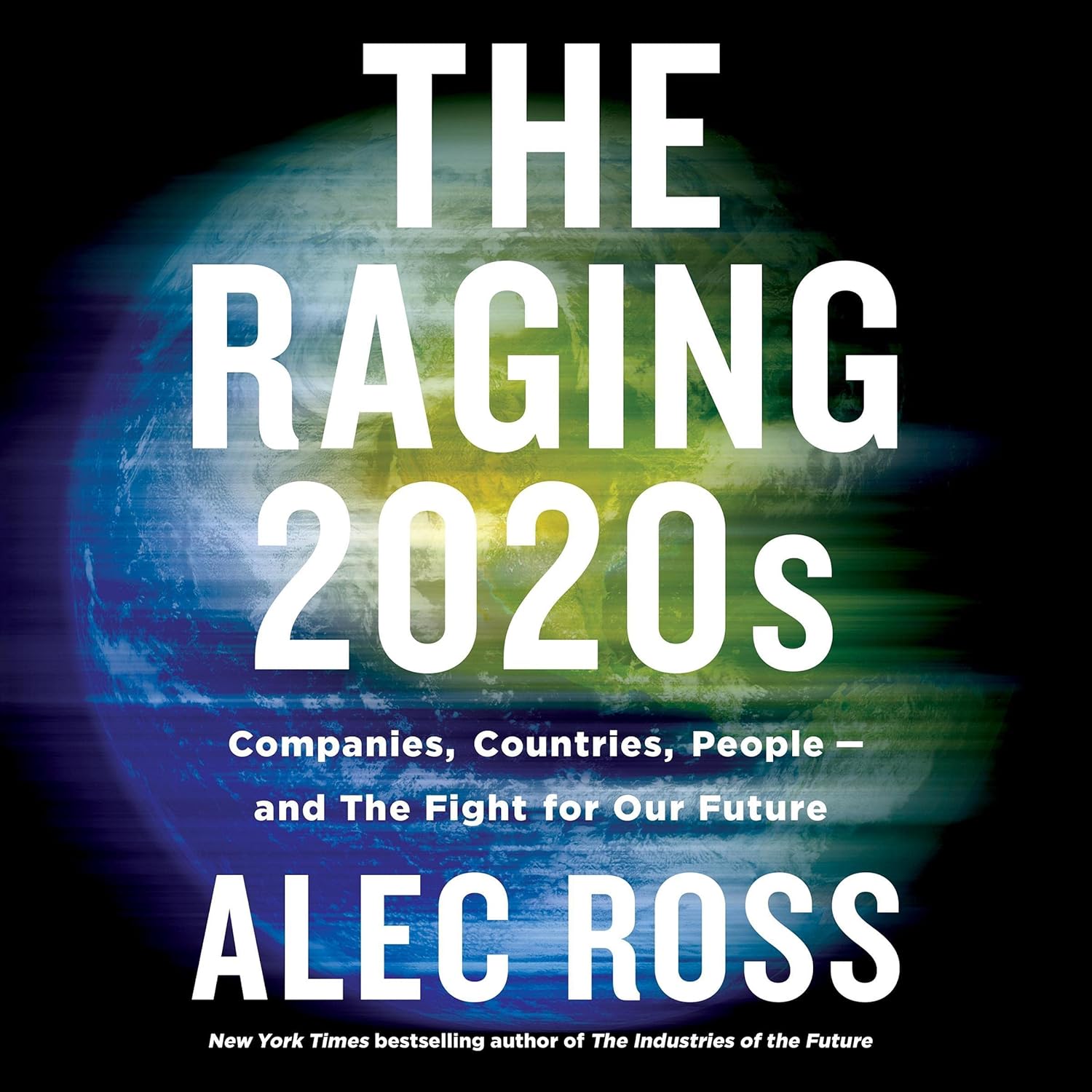
The Raging 2020s: Companies, Countries, People - and the Fight for Our Future
Written by Alec Ross
Review by Erick Watson
The changing roles of corporations, national governments, fellow citizens, and their collective impact on our daily lives are each explored in depth thanks to Mr. Ross’ insightful journalism.
Ross begins his narrative by examining how corporations have evolved during the past fifty years, from ‘tent poles’ of vibrant, nationwide communities after WWII, to the hyper-efficient, coastal, and highly urban capital allocators of today. Particular focus is given to how ideas of shareholder primacy, first popularized by Milton Friedman in the early 1960’s, metastasized into the cancerous ‘grow profit at all costs’ that we witness in most corporations today - what Ross dubs “Mad Max style” capitalism. Innumerable communities that were once thriving hubs of commerce in their own right have since been decimated and bankrupt owing to such uber-capitalist policies. Shareholders have clearly usurped all other Stakeholders in citizen’s implicit social contract with Corporations.
From there, Ross turns our attention to the role of nation states, and how their remit has been slowly eroded and in many ways usurped by corporations, with unlikely assistance from a network of colonial backwaters that now serve as tax havens - not only to wealthy individuals, but to multi-national corporations from every geography on earth. As corporations have relentlessly optimized themselves in service to shareholder profit, increasingly elaborate tax avoidance systems have arisen to legally side-step corporate obligations to governments and their citizens. The result is a race-to-the bottom where nation states compete to undercut one another in offering the most enticing tax savings to large employers, who in turn have no difficulty moving jobs to a still-cheaper jurisdiction.
Corporations seeking the cheapest labor leads naturally to a discussion of citizens, organized labor, globalization, and how our expectations here have gradually evolved as well. From the years immediately following WWII when organized labor was at it’s peak, to today’s globally interconnected and hyper-competitive workforce where most hope of organization becomes easily disintermediated and work is quickly allocated to wherever it can be most efficiently and cheaply accomplished.
Who would have imagined that a handful of islands and micro-states evolved during the height of colonialism hundreds of years ago would have such an impact on our lives this decade? So begins Ross’ analysis of taxation across the globe and how the last gasps of a dying British Empire after WWII led to today’s elaborate system of international tax avoidance. Providing back-doors to avoid taxation in any form has contributed to bankrupting governments around the world, thus degrading whatever social safety nets these nations once held sacrosanct.
This evolution of corporations, nation-states, and individual labor has shockingly set the stage we see clearly today - an international competition of epic proportions between open, democratic societies and closed, autocratic ones. Most Western open democracies are inherently messy, and involve highly varied approaches to providing societal stability and a social safety net for citizens who become buffeted by the winds of hyper-competitive capitalism. Meanwhile there are closed, autocratic societies, led by nations such as China, who ensure social and financial stability for their citizenry in exchange for a surveillance state that enforces compliance and places harsh limits on the liberty of it’s citizens.
Which of these systems of governance will come to dominate? This is the ultimate question Ross places before us as we enter this turbulent decade. Will Western representative governments renew their social contracts, placing their citizenry above corporate greed and in defense of individual liberties, or will more dictatorial regimes prevail?1
Also reviewed: The Tyranny of Merit by Michael J. Sandel
Footnotes
-
(c) by Erick Watson. No AI was used in the creation of this book review. ↩